What Are the 7 Types of Digital Marketing Services?
Digital marketing has become an essential part of how businesses attract customers, generate leads, build brand awareness, and increase sales. But digital marketing is not one single service. It includes several specialized activities, each designed to achieve a different business objective.
So, what are the 7 types of digital marketing services?
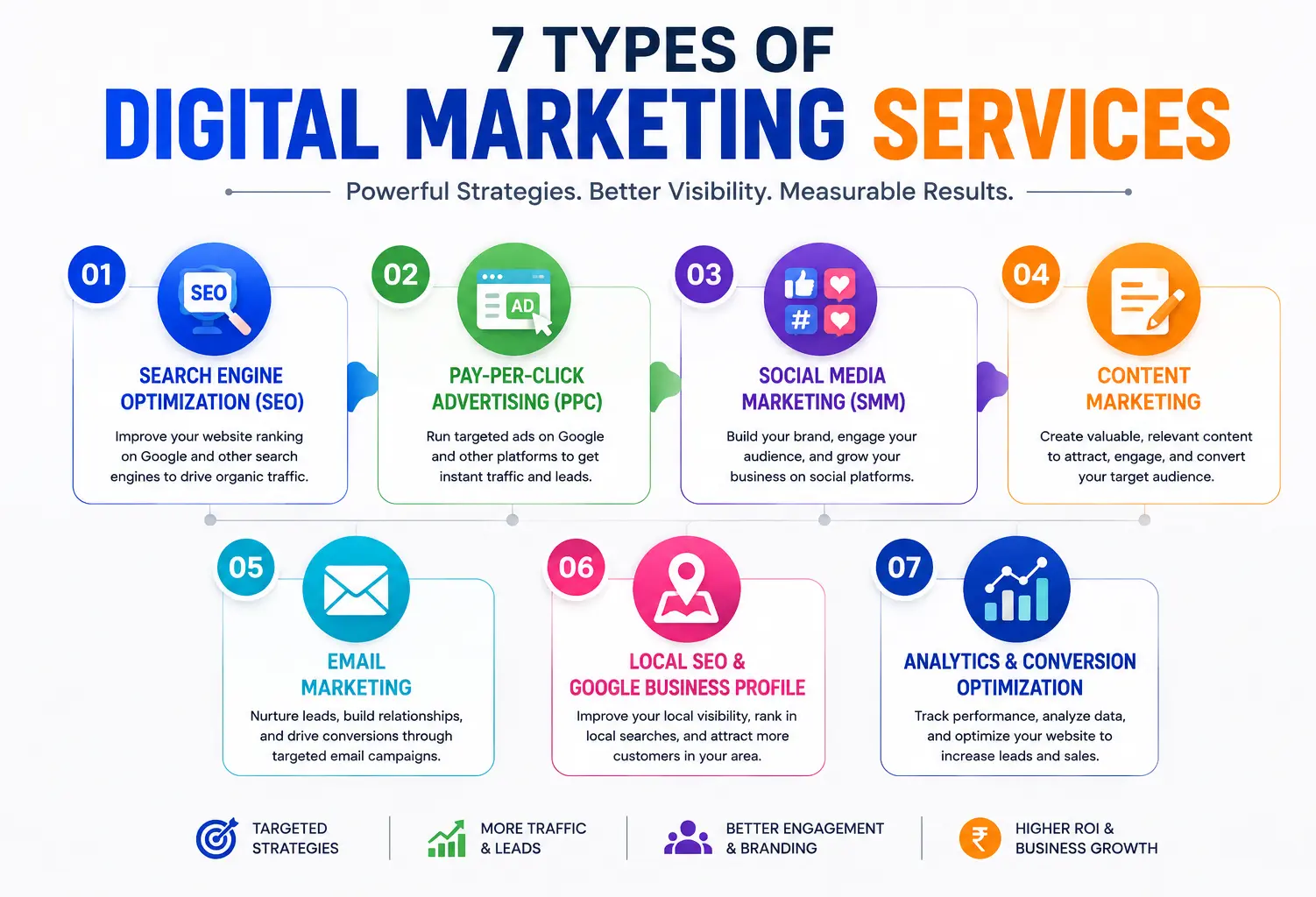
The seven commonly used digital marketing services are Search Engine Optimization (SEO), Pay-Per-Click (PPC) advertising, Social Media Marketing (SMM), Content Marketing, Email Marketing, Affiliate Marketing, and Influencer Marketing.
Each service works differently, and businesses often combine several of them to create a complete digital marketing strategy.
The 7 Types of Digital Marketing Services at a Glance
| Digital Marketing Service | Main Purpose | Common Goal |
|---|---|---|
| SEO | Improve organic search visibility | Increase qualified traffic |
| PPC Advertising | Reach audiences through paid ads | Generate leads or sales |
| Social Media Marketing | Build visibility and engagement | Grow audience and brand awareness |
| Content Marketing | Educate and attract potential customers | Build trust and generate demand |
| Email Marketing | Nurture existing leads and customers | Increase conversions and retention |
| Affiliate Marketing | Use external partners to promote products | Generate performance-based sales |
| Influencer Marketing | Work with creators to reach audiences | Increase awareness and credibility |
Let’s look at each service in more detail.
1. Search Engine Optimization (SEO)
Search Engine Optimization, or SEO, is the process of improving a website and its content so that it can earn relevant visibility in organic search results.
SEO is one of the most important long-term digital marketing services because it can help businesses reach people who are actively searching for information, products, or services.
An SEO strategy may include:
- Keyword and search-intent research
- On-page SEO
- Technical SEO
- Content optimization
- Internal linking
- Local SEO
- Competitor analysis
- Website performance improvements
- SEO reporting and measurement
Example of SEO
Imagine someone searches for “best accounting software for small businesses.”
A software company could create a detailed guide targeting that search intent. By combining useful content with sound technical and on-page SEO practices, the company can potentially attract relevant organic visitors.
SEO is particularly valuable for businesses that want to build sustainable visibility rather than rely entirely on paid advertising.
When should a business invest in SEO?
SEO can be particularly useful when a business:
- Wants consistent organic traffic
- Has valuable information to share
- Operates in a market where customers research before buying
- Wants to build long-term search visibility
- Needs to reduce dependence on paid acquisition
SEO should be viewed as a long-term investment rather than a guaranteed shortcut to rankings.
2. Pay-Per-Click (PPC) Advertising
Pay-Per-Click advertising is a form of paid digital advertising where businesses pay for clicks or other defined advertising outcomes, depending on the platform and campaign model.
PPC can provide businesses with faster access to targeted audiences than organic SEO, although advertising costs continue as campaigns run.
Common PPC channels include:
- Search advertising
- Display advertising
- Shopping advertising
- Social media advertising
- Remarketing campaigns
- Video advertising
A PPC campaign may target audiences based on factors such as search queries, interests, demographics, geographic location, or previous interactions, depending on the advertising platform.
Example of PPC
Suppose a local dental clinic wants to attract patients searching for “dentist near me.”
The clinic could create a paid search campaign targeting relevant searches and direct users to a dedicated appointment page.
The campaign could then be measured using metrics such as:
- Click-through rate (CTR)
- Cost per click (CPC)
- Conversion rate
- Cost per lead
- Return on ad spend (ROAS)
SEO vs PPC
SEO and PPC are often treated as competitors, but they can work together.
SEO builds organic visibility, while PPC provides paid visibility and greater control over advertising campaigns.
A business may use PPC to generate immediate demand while simultaneously developing an SEO strategy for long-term organic growth.
3. Social Media Marketing
Social Media Marketing involves using social platforms to build awareness, engage audiences, distribute content, generate leads, and support business objectives.
Social media marketing can include both organic and paid activities.
Common activities include:
- Social media strategy
- Content creation
- Community management
- Short-form video
- Social advertising
- Influencer collaborations
- Audience engagement
- Social media analytics
Platforms and audience behavior change over time, so businesses should select social channels based on their target customers rather than trying to maintain an identical presence everywhere.
Example of Social Media Marketing
A fashion brand might use short-form videos to demonstrate new products, user-generated content to build social proof, and paid campaigns to reach audiences interested in particular product categories.
The objective isn’t simply to collect likes.
A well-planned social strategy should connect activity to measurable goals such as:
Reach → Engagement → Website visits → Leads → Sales → Customer retention
4. Content Marketing
Content marketing is the creation and distribution of useful, relevant content designed to attract, educate, engage, or retain a specific audience.
Content can take many forms, including:
- Blog posts
- How-to guides
- Case studies
- Videos
- Infographics
- E-books
- Webinars
- Research reports
- Product guides
- FAQs
Content marketing is closely connected to SEO because high-quality content can help businesses address the questions and problems their target audiences are searching for.
Example of Content Marketing
A cybersecurity company could publish an article explaining how small businesses can protect employee accounts from phishing attacks.
The content provides educational value before the reader is necessarily ready to purchase a cybersecurity service.
This approach can help establish expertise and build trust over time.
What makes content marketing effective?
Effective content should:
- Solve a real audience problem
- Match search intent where appropriate
- Provide original or useful insights
- Be factually accurate
- Be easy to understand
- Support the customer journey
- Have a clear purpose
Simply publishing large amounts of generic AI-generated content is not a substitute for expertise, originality, or editorial quality.
5. Email Marketing
Email marketing uses email communication to build relationships with prospects and customers, distribute information, promote products or services, and encourage repeat business.
Unlike some acquisition channels, email allows businesses to communicate directly with people who have voluntarily provided their email address.
Common email marketing activities include:
- Newsletters
- Promotional campaigns
- Welcome emails
- Lead-nurturing sequences
- Product recommendations
- Abandoned-cart emails
- Customer retention campaigns
- Automated email journeys
Example of Email Marketing
An online retailer might send a welcome series after someone subscribes to its newsletter.
The sequence could introduce the brand, explain its products, answer common customer questions, and eventually present a relevant offer.
Email performance can be measured through metrics such as:
- Delivery rate
- Open rate
- Click-through rate
- Conversion rate
- Unsubscribe rate
- Revenue per campaign
Good email marketing focuses on relevance rather than simply sending more messages.
6. Affiliate Marketing
Affiliate marketing is a performance-based marketing model in which external partners promote a company’s products or services and receive compensation for qualifying actions, such as sales or leads.
Affiliates can include:
- Bloggers
- Review websites
- Content creators
- Comparison websites
- Publishers
- Niche websites
The exact payment structure depends on the program.
For example, an affiliate may receive a commission when a customer purchases a product through a tracked referral link.
Example of Affiliate Marketing
A technology website could publish a comparison of several laptops and include tracked affiliate links to participating retailers.
If a reader clicks an affiliate link and completes an eligible purchase, the affiliate may receive a commission according to the program’s terms.
Why do businesses use affiliate marketing?
Affiliate marketing can allow businesses to:
- Reach new audiences
- Work with specialized publishers
- Pay based on defined outcomes
- Expand distribution
- Test new acquisition partnerships
However, businesses should carefully manage affiliate relationships, disclosures, brand guidelines, and tracking.
7. Influencer Marketing
Influencer marketing involves collaborating with creators or individuals who have an established audience and influence within a particular niche.
Influencer marketing can be used for:
- Product awareness
- Product demonstrations
- Reviews
- Launch campaigns
- Social proof
- Brand storytelling
- Community engagement
Influencers don’t necessarily need millions of followers.
For some businesses, a smaller creator with a highly relevant and engaged audience may be more valuable than a celebrity with a large but poorly matched audience.
Example of Influencer Marketing
A skincare company might collaborate with beauty creators who regularly produce educational skincare content.
Instead of simply asking the creator to show the product, the campaign could demonstrate how the product fits into a specific skincare routine.
The business can then evaluate the campaign using appropriate metrics such as reach, engagement, traffic, conversions, or sales.
How Do the 7 Types of Digital Marketing Work Together?
The seven services are most effective when they support one another rather than operate in isolation.
For example, a business launching a new product could use:
SEO to capture relevant search demand.
Content marketing to answer customer questions and demonstrate expertise.
PPC to reach high-intent audiences quickly.
Social media marketing to distribute content and build engagement.
Influencer marketing to introduce the product to relevant communities.
Email marketing to nurture subscribers and existing customers.
Affiliate marketing to generate additional performance-based sales.
This creates an integrated digital marketing ecosystem rather than seven disconnected campaigns.
Which Digital Marketing Service Is Best?
There is no single digital marketing service that is best for every business.
The right combination depends on factors such as:
- Business model
- Target audience
- Industry
- Marketing budget
- Customer buying cycle
- Geographic market
- Competition
- Business objectives
- Available internal resources
For example, a local service business may prioritize local SEO, Google Ads, reviews, and social media, while an e-commerce company may place greater emphasis on SEO, PPC, email, affiliate partnerships, and content marketing.
The best strategy begins with the business objective—not with a particular marketing channel.
How to Choose the Right Digital Marketing Services
Before hiring an agency or building an internal marketing team, ask five questions:
1. What is the primary business goal?
Do you want more:
- Website traffic?
- Leads?
- Sales?
- App downloads?
- Brand awareness?
- Repeat customers?
Your objective should determine your marketing strategy.
2. Where does your audience spend time?
Research how your customers discover information and make purchasing decisions.
There is little value in investing heavily in a channel simply because it is popular if your target audience rarely uses it.
3. How quickly do you need results?
Paid advertising can provide relatively quick campaign data, while SEO and content marketing generally require more time to build organic visibility.
4. Can you measure the outcome?
Every major campaign should have defined KPIs.
For example:
SEO → Organic traffic, rankings, conversions
PPC → CPC, leads, conversions, ROAS
Social media → Reach, engagement, traffic, conversions
Email → Clicks, conversions, revenue, retention
5. Do you have the expertise to manage it?
Digital marketing platforms change frequently. Businesses should consider whether they have the skills to execute campaigns, interpret data, maintain quality, and adapt to changes.
What Is the Most Important Digital Marketing Service?
There isn’t a universal answer.
For many businesses, SEO and content marketing are important for long-term organic visibility. PPC can be valuable when immediate paid reach is required. Email marketing can be powerful for nurturing and retention, while social media and influencer marketing can help brands build communities and awareness.
The most effective approach is usually an integrated strategy where each channel has a defined role.
Frequently Asked Questions
What are the 7 main types of digital marketing?
The seven commonly recognized types are SEO, PPC advertising, social media marketing, content marketing, email marketing, affiliate marketing, and influencer marketing.
Which type of digital marketing is most effective?
Effectiveness depends on the business, audience, industry, budget, and objective. There is no single channel that produces the best results for every organization.
What is the difference between SEO and PPC?
SEO focuses on earning organic search visibility, while PPC uses paid advertising to reach targeted audiences. SEO can support long-term visibility, while PPC can provide more immediate paid exposure.
Is social media part of digital marketing?
Yes. Social media marketing is a major category of digital marketing that includes organic content, community engagement, and paid social advertising.
Is content marketing the same as SEO?
No. They overlap but are different. Content marketing focuses on creating useful content for an audience, while SEO focuses on improving discoverability and organic search performance. High-quality content can be an important part of an SEO strategy.
Which digital marketing service is best for small businesses?
There is no universal answer. Many small businesses can benefit from a combination of local SEO, content, paid search, social media, and email marketing, depending on their customers and business model.
Final Thoughts
The 7 types of digital marketing services—SEO, PPC, social media marketing, content marketing, email marketing, affiliate marketing, and influencer marketing—cover different stages of the modern customer journey.
The biggest mistake businesses can make is choosing marketing channels simply because they are popular.
Instead, start with the customer:
Who are they? What problem are they trying to solve? Where do they look for information? What makes them trust a business? What action do you want them to take?
Once those questions are answered, you can select the digital marketing services that best support your objectives.
A strong digital marketing strategy isn’t about being everywhere. It’s about being useful, credible, measurable, and present in the places that matter to your audience.