What Is the 70/20/10 Rule in Digital Marketing?
Digital marketing requires businesses to balance proven strategies with new ideas and long-term experimentation. One useful framework for managing this balance is the 70/20/10 rule.
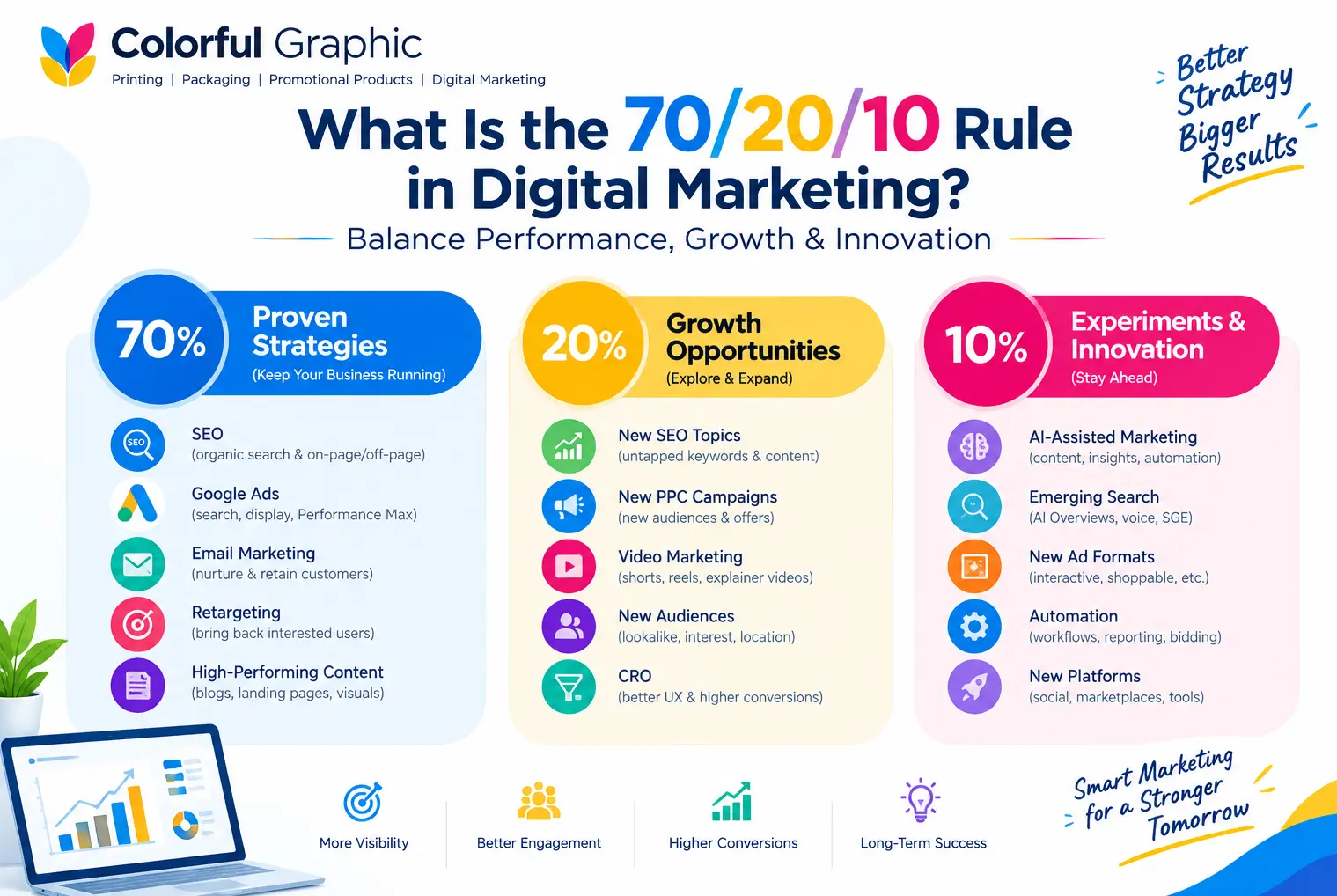
The 70/20/10 rule in digital marketing suggests allocating approximately 70% of your marketing resources to proven strategies, 20% to developing opportunities, and 10% to experimental or high-risk ideas.
This framework helps businesses protect their existing marketing performance while continuing to test new channels, technologies, content formats, audiences, and campaigns.
What Does the 70/20/10 Rule Mean?
The 70/20/10 rule divides a digital marketing budget, time, resources, or effort into three categories:
- 70% – Proven strategies: Activities that consistently generate results.
- 20% – Growth opportunities: Strategies that have potential but require further optimization.
- 10% – Experiments: New or innovative ideas where the outcome is uncertain.
The percentages are not strict requirements. They provide a practical framework for deciding how much of your marketing investment should go toward reliable performance versus innovation.
For example, if a company has a monthly digital marketing budget of ₹1,00,000, it could use the framework as follows:
| Allocation | Percentage | Example Budget | Purpose |
|---|---|---|---|
| Proven strategies | 70% | ₹70,000 | Maintain successful campaigns |
| Growth opportunities | 20% | ₹20,000 | Test promising strategies |
| Experiments | 10% | ₹10,000 | Explore new ideas |
The actual allocation should depend on the company’s goals, industry, customer journey, competition, and available resources.
How Does the 70/20/10 Rule Work in Digital Marketing?
The framework works by creating three levels of marketing investment.
1. 70%: Focus on Proven Marketing Strategies
The largest portion of your resources should support marketing activities that already demonstrate measurable results.
Examples include:
- SEO campaigns that consistently increase organic traffic
- Google Ads campaigns generating qualified leads
- High-performing landing pages
- Email campaigns with strong engagement
- Social media content formats that consistently perform
- Retargeting campaigns
- Content that regularly generates leads
- Local SEO activities that improve visibility
The objective of the 70% category is consistency and performance.
Instead of continuously changing successful campaigns, businesses can optimize them gradually by improving conversion rates, reducing acquisition costs, increasing qualified traffic, or expanding successful keyword and audience segments.
2. 20%: Invest in Growth Opportunities
The next 20% should be allocated to strategies that are promising but have not yet become core marketing channels.
These activities may include:
- Expanding SEO into a new topic cluster
- Testing a new PPC campaign
- Targeting a new customer segment
- Creating video content
- Developing a new lead-generation funnel
- Testing LinkedIn advertising
- Expanding into a new geographic market
- Improving conversion rate optimization
- Testing new content formats
The purpose of this category is to identify strategies that could eventually move into the 70% proven-strategy group.
For example, a company may discover that its educational video content generates qualified leads. Initially, video may belong to the 20% category. If the results become consistent, the company could increase its investment.
3. 10%: Experiment With New Ideas
The final 10% is reserved for experimentation.
This is where marketers can test emerging technologies, unconventional campaigns, or new platforms without putting the entire marketing strategy at risk.
Examples include:
- Generative AI-assisted content workflows
- New social media platforms
- Experimental ad formats
- Interactive content
- AI-powered personalization
- New search experiences
- Emerging content distribution channels
- Innovative marketing automation
- New audience targeting methods
Not every experiment will succeed. That is expected.
The purpose of the 10% allocation is to discover opportunities that could provide a competitive advantage in the future.
Why Is the 70/20/10 Rule Important?
Digital marketing changes rapidly. Search algorithms evolve, customer behavior changes, advertising platforms introduce new features, and new technologies appear regularly.
If a company invests only in proven strategies, it may eventually fall behind competitors that experiment with new opportunities.
On the other hand, investing too heavily in untested strategies can create unnecessary risk.
The 70/20/10 framework creates a balance between:
Performance + Growth + Innovation
This allows marketers to continue generating results while preparing for future changes.
What Is an Example of the 70/20/10 Rule in SEO?
Suppose an ecommerce company has a strong SEO program.
Its allocation could look like this:
70% – Existing SEO performance
The company focuses on:
- Optimizing existing ranking pages
- Building relevant internal links
- Improving technical SEO
- Updating high-performing content
- Monitoring organic traffic
- Improving Core Web Vitals
- Optimizing product and category pages
20% – SEO growth
The company tests:
- New topic clusters
- New product categories
- Digital PR campaigns
- New content formats
- Additional commercial keywords
- Location-based SEO
10% – SEO experimentation
The company experiments with:
- AI-focused search optimization
- Answer-focused content
- New structured content formats
- Emerging search platforms
- New approaches to entity optimization
The exact activities will vary, but the principle remains the same: protect current SEO performance while creating room for growth and experimentation.
What Is an Example of the 70/20/10 Rule in Google Ads?
The same approach can be applied to paid advertising.
For example, a company spending ₹2,00,000 per month on digital advertising might structure its resources around:
70%: Existing high-performing Search or Performance Max campaigns
20%: New audiences, keywords, campaign types, or geographic markets
10%: Experimental ad formats, new targeting methods, creative concepts, or emerging platforms
The goal is not simply to spend money according to fixed percentages. The goal is to establish a risk-managed testing framework.
Can the 70/20/10 Rule Be Used for Content Marketing?
Yes. The framework can be particularly useful for content marketing.
A company could use:
70% for proven content
This might include blog articles, guides, product content, case studies, or videos that already attract relevant traffic and conversions.
20% for new content opportunities
Examples include new topics, new customer segments, comparison content, industry research, or different content formats.
10% for content experiments
This could include interactive tools, original data studies, AI-assisted content experiments, podcasts, new video formats, or other innovative approaches.
This approach prevents a content team from producing only the same type of content repeatedly.
How Does the 70/20/10 Rule Support AEO and GEO?
Modern search behavior is moving beyond traditional blue-link search. Users increasingly expect direct answers, summaries, recommendations, and information from AI-powered search experiences.
The 70/20/10 framework can help businesses adapt.
For example:
70% – Strengthen existing SEO foundations
- Helpful and original content
- Strong internal linking
- Search intent alignment
- Technical SEO
- Clear page structure
- Relevant entities and topics
- Author and business credibility
20% – Build answer-focused content
- Frequently asked questions
- Comparison pages
- How-to content
- Concise definitions
- Expert explanations
- Structured answers to customer questions
10% – Experiment with emerging search strategies
- AI search visibility
- Generative search optimization
- New content structures
- Conversational queries
- Entity-focused content strategies
- Emerging AI discovery platforms
The percentages should be adapted to the business rather than treated as a universal formula.
What Are the Benefits of the 70/20/10 Rule?
The framework provides several practical benefits.
1. Reduces Marketing Risk
Most resources remain focused on strategies that already work, while only a smaller portion is used for experimentation.
2. Encourages Innovation
Teams have dedicated resources for testing new ideas instead of avoiding experimentation because of short-term performance concerns.
3. Supports Long-Term Growth
Successful experiments can gradually become part of the core marketing strategy.
4. Improves Resource Allocation
The framework makes it easier to decide where budget, time, employees, and technology should be invested.
5. Creates a Testing Culture
Marketing teams can test ideas systematically rather than making random changes.
6. Helps Businesses Adapt
Because digital marketing changes quickly, maintaining an experimentation budget can help businesses identify new opportunities earlier.
Is the 70/20/10 Rule a Strict Formula?
No. The 70/20/10 rule should be treated as a guideline rather than a fixed mathematical formula.
A startup entering a new market may need to experiment more aggressively. An established company with predictable acquisition channels may prefer a larger investment in proven strategies.
For example, a business could use:
- 80/15/5 during a period of uncertainty
- 70/20/10 for balanced growth
- 60/25/15 when pursuing aggressive innovation
The right allocation depends on business objectives, risk tolerance, marketing maturity, and available data.
How Should You Implement the 70/20/10 Rule?
Follow these steps to introduce the framework into your marketing strategy.
Step 1: Identify Your Proven Channels
Review your SEO, PPC, social media, email, content, and other marketing activities.
Identify which channels consistently generate traffic, leads, sales, or other valuable business outcomes.
Step 2: Identify Growth Opportunities
Look for channels or strategies that have delivered early positive signals but require additional investment.
Step 3: Create an Experimentation Budget
Reserve a defined percentage of your marketing resources for testing new ideas.
Step 4: Define Success Metrics
Every experiment should have measurable objectives.
Depending on the campaign, these could include:
- Organic traffic
- Qualified leads
- Conversion rate
- Cost per lead
- Customer acquisition cost
- Return on ad spend
- Revenue
- Engagement
- Search visibility
Step 5: Test and Analyze
Run experiments for a reasonable period and compare the results against predefined benchmarks.
Step 6: Scale Successful Experiments
When an experiment consistently produces strong results, increase investment and consider moving it into the growth or proven-strategy category.
Step 7: Stop Underperforming Experiments
Not every idea deserves additional investment. Use data to determine whether an experiment should be improved, paused, or discontinued.
Common Mistakes When Using the 70/20/10 Rule
Businesses can reduce the effectiveness of this framework by applying it incorrectly.
Treating the Percentages as Fixed
The 70/20/10 split is a guideline. It should be adjusted according to business circumstances.
Experimenting Without Clear Goals
A test without a measurable objective makes it difficult to determine whether the experiment was successful.
Changing Too Many Variables
Testing several major changes simultaneously can make it difficult to identify what caused the result.
Ignoring Successful Campaigns
The 70% category should not mean “do the same thing forever.” Proven campaigns should continue to be optimized.
Giving Up Too Quickly
Some marketing experiments require enough time and data before a reliable conclusion can be made.
70/20/10 Rule vs. Traditional Marketing Planning
Traditional marketing planning often focuses heavily on channels that have historically generated results.
The 70/20/10 framework adds another dimension: planned experimentation.
Instead of asking only:
“What worked last year?”
Marketers can also ask:
“What is working now, what could work next, and what should we test for the future?”
This mindset can make digital marketing more adaptable.
Frequently Asked Questions About the 70/20/10 Rule
What is the 70/20/10 rule in simple terms?
The 70/20/10 rule means allocating about 70% of marketing resources to proven strategies, 20% to promising growth opportunities, and 10% to experiments and innovation.
Who should use the 70/20/10 rule?
Businesses of different sizes can use the framework, including startups, small businesses, ecommerce companies, agencies, SaaS companies, and large enterprises.
Does 70/20/10 mean budget allocation only?
No. It can be applied to marketing budget, employee time, campaign resources, content production, testing, or overall strategic effort.
Can the 70/20/10 rule be used for SEO?
Yes. It can help SEO teams balance optimization of existing successful pages, development of new growth opportunities, and experimentation with emerging search strategies.
Is 70/20/10 the best marketing budget split?
There is no universally correct marketing budget split. The 70/20/10 rule is a strategic framework, and businesses should adjust it according to their objectives, industry, data, and risk tolerance.
What happens when a 10% experiment succeeds?
A successful experiment can receive additional investment and move into the 20% growth category. If it becomes consistently effective, it may eventually become part of the 70% proven strategy group.
Final Thoughts
The 70/20/10 rule in digital marketing provides a simple way to balance today’s performance with tomorrow’s opportunities.
The 70% protects the strategies that already generate results. The 20% creates room for growth, while the 10% gives marketing teams permission to experiment with new ideas.
The most important principle is not the exact percentage. It is the mindset behind the framework:
Protect what works, develop what shows potential, and experiment with what could become the next major opportunity.
When supported by clear KPIs, regular analysis, controlled testing, and continuous optimization, the 70/20/10 framework can help businesses build a digital marketing strategy that is both performance-focused and future-ready.